







SpaceX Vow To Loft 1 Million AI Satellites Could Spark Doomsday Dive
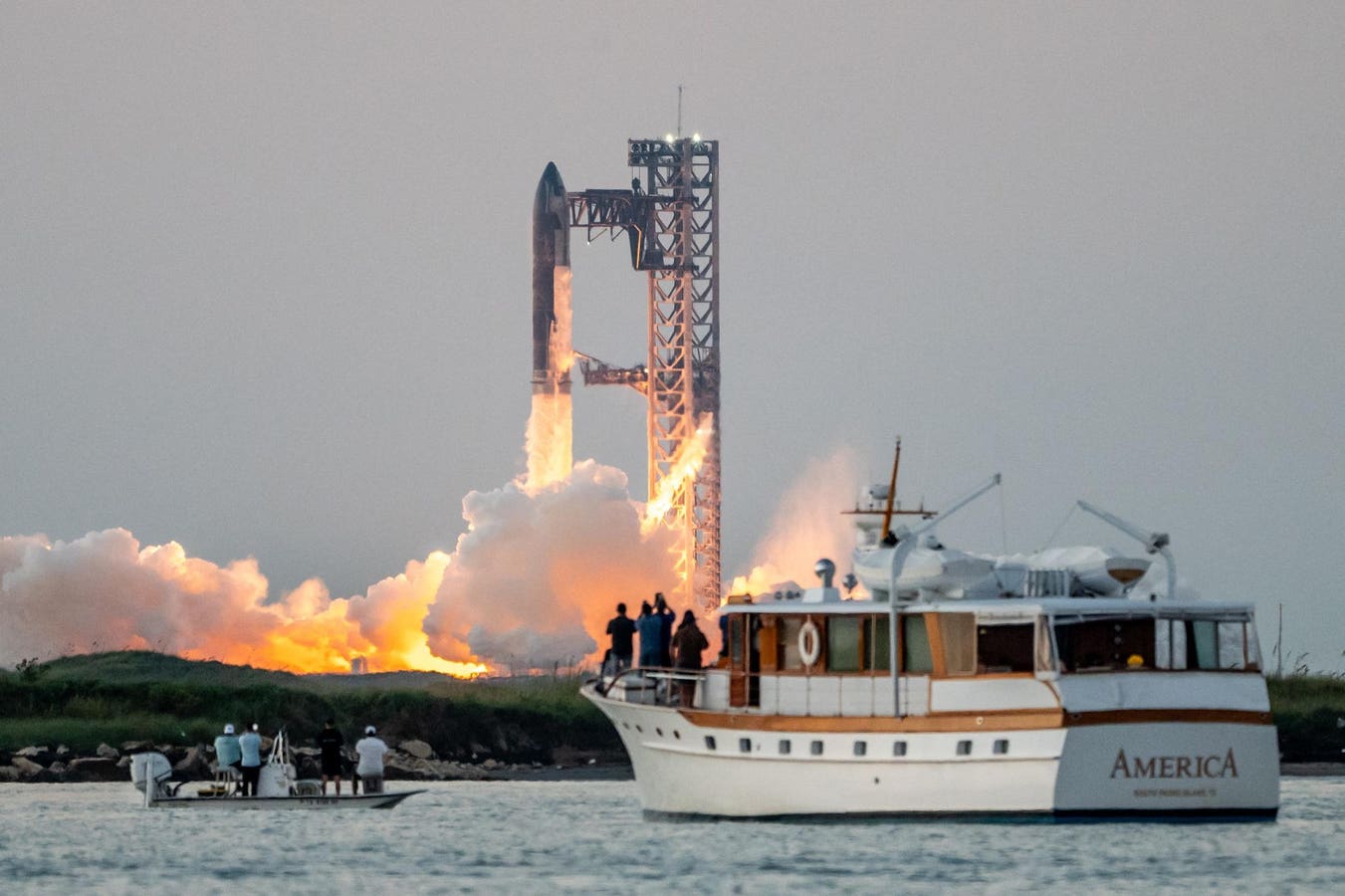
Elon Musk has vowed to begin launching one million AI data center satellites into orbit in 2028, via the still experimental Starship rocket, in a high-risk plan that could trigger a financial catastrophe, and send SpaceX into a high-speed nosedive. (Photo by SERGIO FLORES/AFP via Getty Images)AFP via Getty ImagesElon Musk’s plan to begin launching one million AI data center satellites into orbit in 2028 could trigger a financial catastrophe, sending SpaceX into a high-speed nosedive, say leading North American space scholars.
In what could be viewed as a precursor project, SpaceX has already lofted 10,000 Starlink broadband-beaming satellites, with each spacecraft costing US$2 million to build and launch, says Robert Zubrin, one of the world’s top rocket designers.
Using the same SpaceX spacecraft assembly and launch systems to lift one million AI satellites into low Earth orbit could cost roughly $2 trillion, or the entire projected valuation of the world-leading spacecraft outfit following its upcoming initial public offering (IPO) of shares.
If SpaceX’s founder actually moves forward with his sci-fi-like masterplan to construct this mega-constellation for spacefaring AI agents, that could spark the lightning-speed halt of his long-running winning streak in business, Zubrin told me in an interview.
Dr. Zubrin, who designed an early prototype of NASA’s Space Launch System Moon rocket, which just sent four Allied astronauts on a circumlunar space trek, says lofting satellites to host next-generation artificial intelligence models like OpenAI’s ChatGPT and Google’s Gemini would be astronomically more expensive than terrestrial data centers.
MORE FOR YOUAerospace engineer Robert Zubrin designed an early prototype of the Space Launch System super-rocket, which just sent four Allied astronauts on a trek around the Moon. (Photo by Jim WATSON / AFP via Getty Images)AFP via Getty ImagesDuring the countdown to the SpaceX IPO and listing, its commander-in-chief posted a mission statement on the outfit’s website stating: “Launching a constellation of a million satellites that operate as orbital data centers” would support “AI-driven applications for billions of people today and ensuring humanity’s multi-planetary future.”
Promising to launch the next-generation Starship super-capsule once every hour to rocket these satellites hundreds of kilometers above the Earth, Musk predicted: “My estimate is that within 2 to 3 years, the lowest cost way to generate AI compute will be in space.”
While SpaceX recently completed the 12th flight test of its Starship, with the upper stage making a picture-perfect splashdown in the Indian Ocean, its first-stage rocket made an unscheduled kamikaze dive into the Gulf of Mexico after its 33 engines failed to reignite for a boost-back burn.
SpaceX has led a remarkable rocket revolution with its reusable Falcon 9 booster, but its colossal Starship is still undergoing a series of flight tests. (Photo by Joe Raedle/Getty Images)Getty ImagesMusk ultimately aims to recover both stages, via titanic robotic arms attached to the launch tower, and slash launch prices in the process.
NASA’s leaders initially commissioned SpaceX, back in 2021, to shuttle their astronauts from a Moon-orbiting capsule down to the lunar South Pole. But a cascade of delays in demoing the Starship in orbit caused them to reopen the lunar landing competition, and SpaceX is now facing off against Blue Origin in a race to complete a lunar touchdown spacecraft by 2028.
SpaceX’s chief designer prophesied in his Web-posted missive that: “The capabilities we unlock by making space-based data centers a reality will fund and enable self-growing bases on the Moon, an entire civilization on Mars and ultimately expansion to the Universe.”
Dr. Zubrin told me SpaceX has led a revolution in the design of reusable spacecraft with its Falcon 9 rocket.
SpaceX is now the global superpower in terms of total rocket launches, with an average of three lift-offs per week in 2025, more than NASA or any other government space agency.
But to skyrocket from that flight cadence to one launch every hour, or 8700 flights every year, with the still unproven Starship by 2028 is unimaginable.
Likewise, Zubrin says, “Launching a million satellite orbital data center constellation is fantasy.”
Dr. Zubrin is not only at the global forefront in aeronautical engineering, but also founded the Mars Society, a planet-spanning think tank and design studio to promote terraforming and colonizing the Red Planet.
He has known Elon Musk for a quarter century, since Musk made a contribution to the Society and was briefly named to its board of directors, before he founded SpaceX with the goal of speeding the first human explorers to the Martian dunes.
Since then, Zubrin has been a de facto mentor to Musk, trumpeting his spaceflight triumphs and his goal of creating the first hyper-tech cosmopolis on Mars, but also warning against strategic missteps that could jeopardize that quest, like the new quixotic, out-of-the-blue scheme to rocket generative AI agents to circle the Earth.
The American space seer says he wrote an appeal to Musk, published in a magazine article, to caution him against the cosmic boondoggle of constructing a mega-cluster of space-based data centers that could not compete economically with terrestrial counterparts.
To an outside observer, especially neophytes to the spaceflight sector, Musk’s masterplan for the super-constellation might seem like a logical progression after he assembled the rings of Starlink satellites that now transmit internet connections to 10 million people across the face of the Earth.
SpaceX’s master architect, Zubrin writes in the appeal, “takes things step by step, with each step providing the ample financial basis that enables the next.”
“He helped create PayPal, which gave him the funds to launch SpaceX.”
“The SpaceX Falcon 9 became a money maker, which enabled him to launch Starlink.”
“Starlink has not only made him even richer, it has made him far more powerful than any other businessman on Earth.”
SpaceX’s Starlink satellites have not only helped skyrocket Elon Musk across the pantheon of space-tech demigods, but also have “made him far more powerful than any other businessman on Earth.” (Photo by: Alan Dyer/VW Pics/Universal Images Group via Getty Images)VW Pics/Universal Images Group via Getty ImagesBut the new scheme to build sensationally costly and colossal bands of AI satellites, Zubrin adds, could lead to SpaceX’s financial crash and burn.
Musk proposes powering these super-armadas of satellites with solar panels.
But Zubrin, echoing a host of other eminent space scholars, says that now, and for the foreseeable future, “space solar power is vastly more expensive than solar power on Earth, and even that is not fully competitive with fossil fuels, hydro, or nuclear.”
The solar panels on each SpaceX Starlink satellite generate 20 kilowatts of electric power. The $2,000,000 price tag on each of these spacecraft means one kilowatt of power costs $100,000, Zubrin says.
In contrast, he adds, solar arrays positioned on rooftops scattered across the planet produce electricity that costs about $3000 per kilowatt, while power from gas-fired generators costs roughly $1000 per kilowatt.
Zubrin, who holds a doctorate degree in nuclear engineering, says commercial nuclear power plants produce power at $5000 to $10,000 per kilowatt.
Any of these terrestrial power options, he points out, would be far cheaper than the solar wings that Elon Musk has proposed to fly his AI spacecraft.
While the Starlink satellites have to be sent into orbit to beam internet connections to users across the continents, Zubrin says, there is no comparable need to send AI data centers into space, especially one that would justify the sky-high price tag on each spacecraft.
Brian Hurley, founder of the influential New Space Economy think tank and digital magazine, told me in an interview that top researchers worldwide on the potential launch of orbital data centers customized to host AI models have reached a consensus that these stations will not become economically feasible until the mid-2030s.
A world-leading expert who chronicles the rapid-fire expansion of the modern space sector, and its rippling effects across the spheres of national security and international affairs, Canada-based Hurley points to a just-published study titled “Towards a future space-based, highly scalable AI infrastructure system design,” co-authored by nine vanguard Google scholars on AI and spaceflight, that predicts these AI space stations might only become competitive with terrestrial data centers around the middle of the next decade.
“High launch costs have historically stymied efforts to harvest solar power in space on large scales,” the Google scholars say in their frontier paper.
Researchers at Google, creator of the Gemini artificial intelligence model, are now working on a “moonshot” exploration of launching AI labs into orbit in the future (Photo by Jonathan Raa/NurPhoto via Getty Images)NurPhoto via Getty ImagesYet “there is a feasible path for launch costs to drop sufficiently to no longer be prohibitive.”
If SpaceX succeeds in making the Starship fully reusable, the Google researchers predict, and the ship’s average launch cost to low Earth orbit ultimately plummets to $200/kilogram, “a space-based system could achieve performance roughly comparable to a terrestrial datacenter.”
They also forecast that if SpaceX reaches a cadence of “∼180 Starship launches/year, launch prices could fall to

 1INCH
1INCH  0x Protocol
  3lon
3lon  $1 is all you need
  1GUY
1GUY