







China Cuts 12,200 University Programs, Replaces Many With AI Degrees
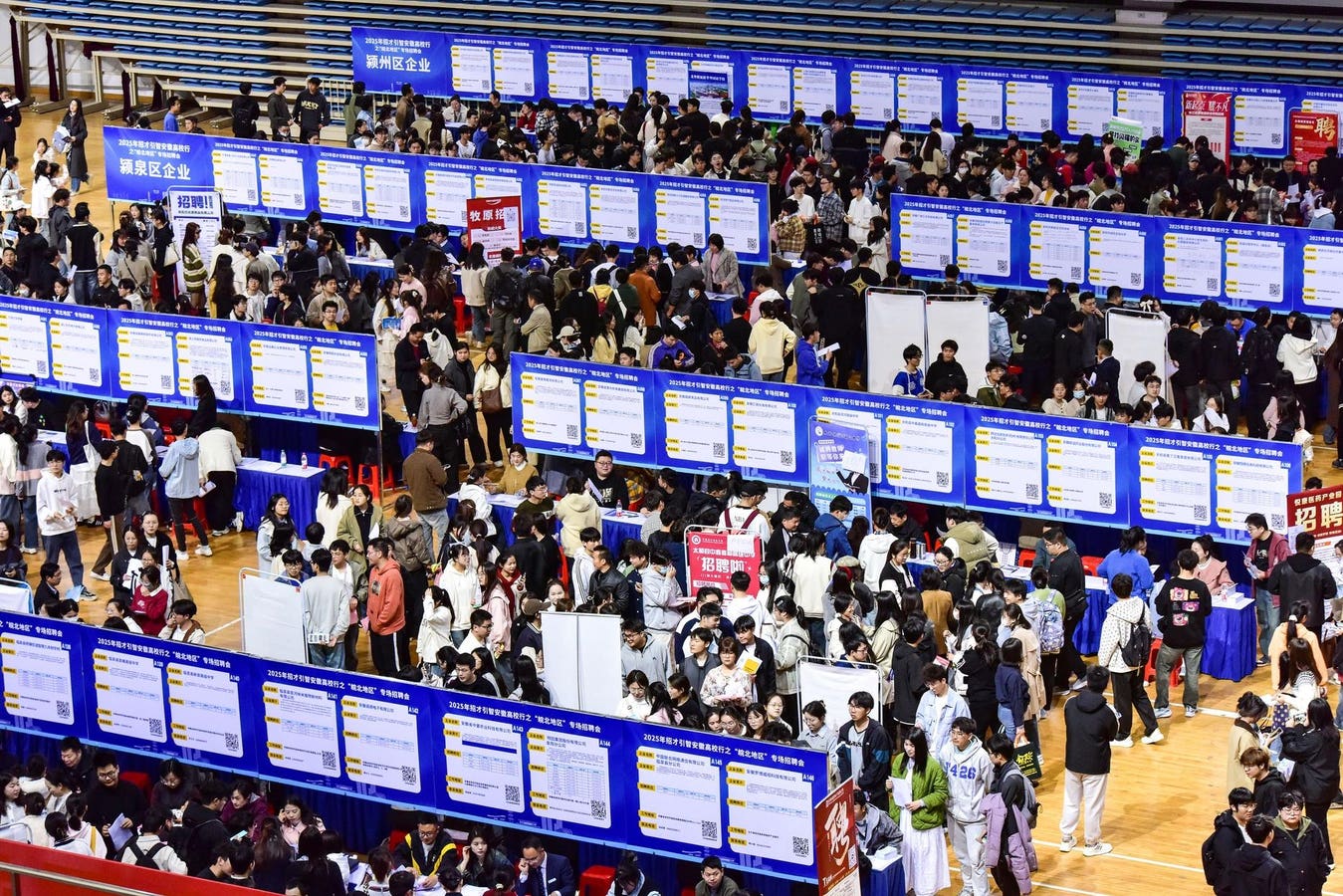
High youth unemployment, evident in annual job fairs packed with university graduates seeking work, has prompted China to eliminate “obsolete” degree programs that do not lead directly to employment.CFOTO/Future Publishing via Getty ImagesChina is making one of the most sweeping higher education reforms in its modern history, eliminating thousands of university degree programs considered to be outdated while rapidly expanding programs centered on artificial intelligence and other emerging technologies.
Between 2021 and 2025, Chinese universities ended or suspended 12,200 undergraduate degree programs and introduced about 10,200 new ones, according to Ministry of Education data cited by Xinhua, China’s official state news agency. More than 30% of undergraduate programs across the country were affected by the restructuring.
China’s youth employment challenges are likely to have helped drive this change. In March, the urban unemployment rate for 16- to 24-year-olds who were not students rose to 16.9%, up from 16.1% in February. Unemployment also increased among 25- to 29-year-olds, rising to 7.7% from 7.2%, while the rate for workers aged 30 to 59 edged up to 4.3% from 4.2%.
University Degrees Realigned With National StrategyThe reductions have fallen disproportionately on programs in the humanities, arts, foreign languages and some management disciplines. According to the South China Morning Post, the programs that were cut were in fields viewed as “obsolete.”
At the same time, institutions have been encouraged to expand offerings in artificial intelligence, robotics, semiconductor engineering, AI-driven advanced manufacturing and other fields aligned with China’s industrial priorities.
MORE FOR YOUThe initiative reflects two powerful forces reshaping China’s higher education system.
The first is the country’s determination to become a global leader in advanced technologies. Artificial intelligence has become a national strategic priority, with Beijing investing heavily in research, semiconductor development, automation and advanced manufacturing. Universities are increasingly viewed as part of that industrial strategy.
The second is growing graduate employment. China now produces more than 12 million university graduates each year, yet many struggle to find work in fields related to their degrees. Policymakers have concluded that universities must respond more quickly to labor market demands by redirecting students toward sectors expected to experience sustained growth.
Program Cuts In The U.S. But For Different ReasonsThe restructuring underway in China stands in sharp contrast to what is happening across much of American higher education. In the U.S., universities facing financial pressures have increasingly responded by cutting programs, freezing hiring and, in some cases, laying off faculty and staff. Those cuts are often driven by declining enrollment, demographic shifts, falls in international students and budget deficits.
China’s decision to eliminate thousands of academic programs is driven by a fundamentally different rationale. Rather than simply shrinking to save money, the government is redirecting educational capacity toward sectors it considers strategically important. The result is not a broad retrenchment of higher education, but a large-scale reallocation of resources intended to align universities more closely with the country’s economic priorities.
The contrast also reflects the very different roles government plays in higher education. In China, the central government exercises extensive oversight of universities and can steer academic priorities through national policy and funding decisions. In the U.S., colleges and universities operate with far greater institutional autonomy, with academic offerings shaped primarily by institutional leadership, faculty, governing boards, market demand and state governments rather than by a single national strategy.
Whether China’s course correction succeeds remains to be seen. But its willingness to rapidly realign higher education around national priorities highlights the growing role universities play in economic competitiveness – a debate that is also gaining urgency in the U.S.


 1INCH
1INCH  0x Protocol
  3lon
3lon  $1 is all you need
  1GUY
1GUY